Every Morrison guide on the internet says the same three things. Estate lots. Century canopy. Build your dream home. That summary was accurate for a decade, and it is the reason buyers anchor to a teardown thesis the moment they see a 1960s bungalow on a 100-foot frontage south of Cornwall. In the spring of 2026, that thesis is doing more work than the math supports.
The friction is not in the listing photos. It is in the permit office. Oakville's Private Tree Protection Procedure was rewritten in March 2024, and the change has quietly re-rated which Morrison lots are actually buildable in the way buyers imagine, which ones are only partially buildable, and which ones now carry a redevelopment discount the sold record has begun to reflect.
One MLS Label, Three Different Products
The 1011-MO Morrison code on the local board covers a market most buyers read as a single price point. As of June 6, 2026, Morrison carried 78 active listings with a median list price of $3,998,944 and an average of roughly $844 per square foot, sitting on the market an average of 48 days. Set that against Halton's broader picture: the OMDREB MLS HPI composite benchmark was $1,041,700 in April 2026, falling 9.5% year over year, with the single-family benchmark at $1,252,700, down 10.3%. Morrison's median list is roughly four times the surrounding board benchmark, which makes the "average" a number to interrogate rather than rely on.
Pull the listings apart and three distinct sub-products emerge inside that one MLS tag.
| Sub-product | Typical lot | Typical price band | What the buyer is really paying for |
|---|---|---|---|
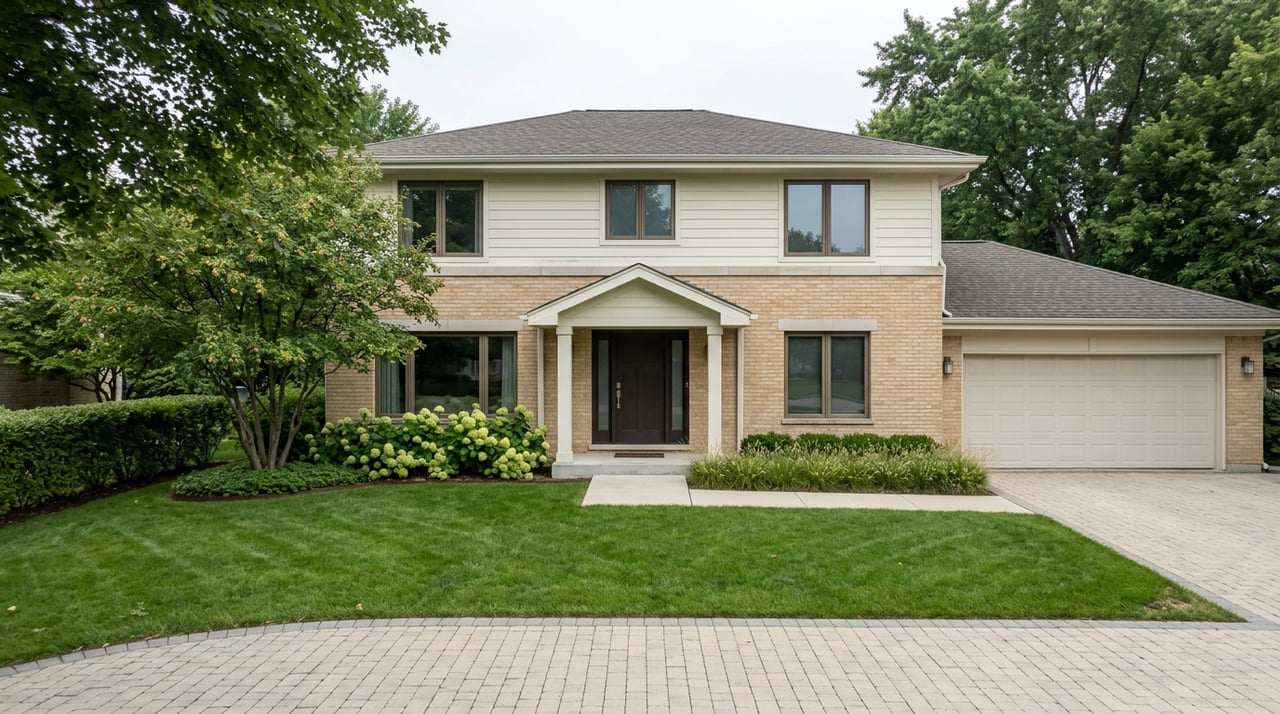
| Established executive home | 60–80 ft frontage, interior streets | $2M–$3M | Move-in or light-renovation home in the school catchment |
| Renovated or newer custom | 80–100 ft frontage, mature canopy | $3M–$5M | Recently built or substantially rebuilt house with finished landscape |
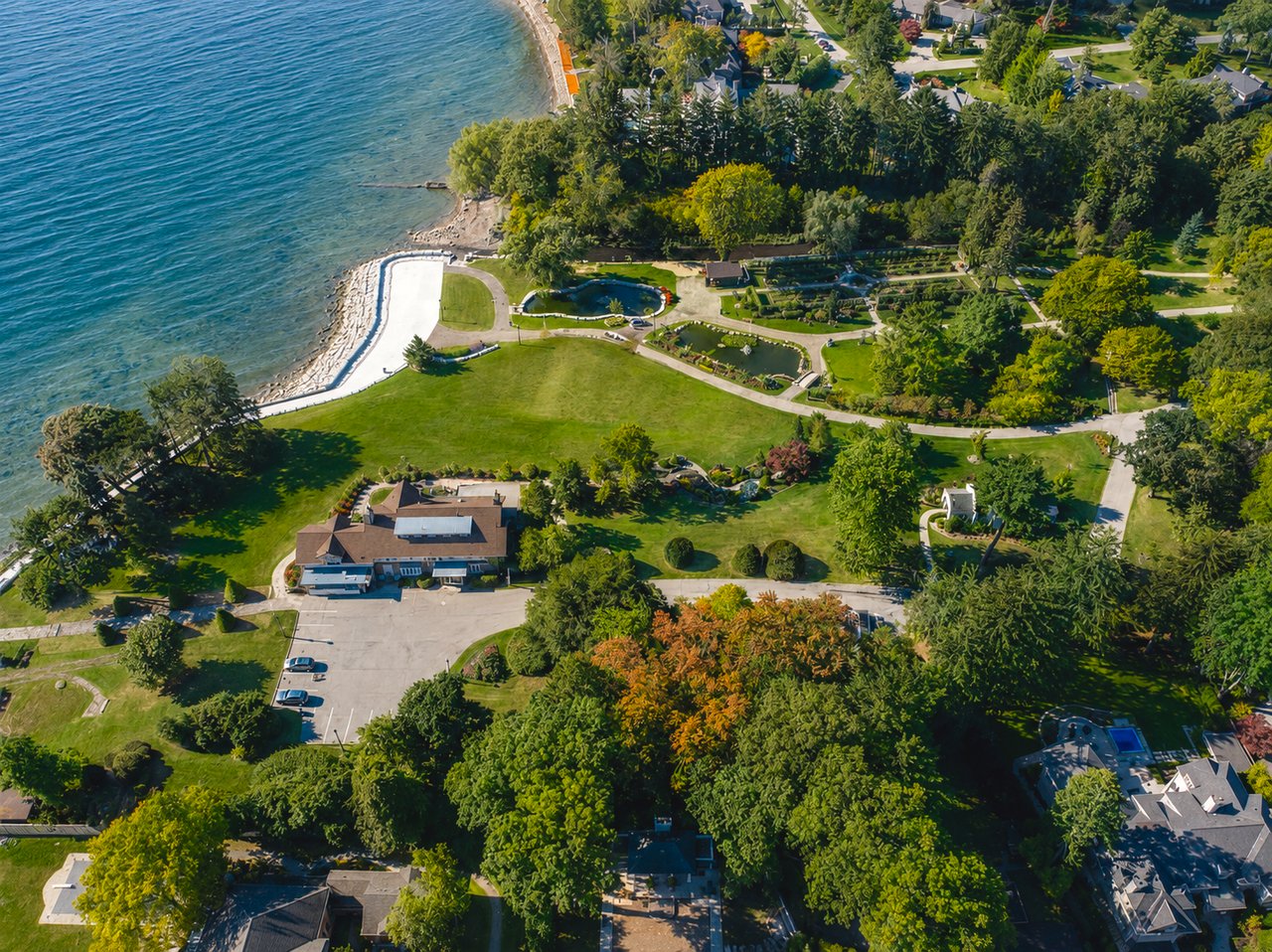
| Gold Coast estate | Lakeshore Road East frontages, half-acre and up | $5M–$15M+ | Land, privacy, water proximity, and provenance |
The bands matter because the May 2026 transaction record almost perfectly straddles the first two. In May 2026, the $2 million to $3 million and $3 million to $5 million price bands each produced nine transactions, making them equally the most active segments, two properties transacted above $5 million, and only four transactions fell below $2 million. That spans Ford, Morrison, and Old Oakville combined, but Morrison contributes the bulk of the upper bands. The "centre" of this market is a $2M to $5M established-home trade, not the Lakeshore estate the marketing photos lean on.
What the Sold Record Is Actually Telling You
May 2026 produced 24 detached transactions across Ford, Morrison, and Old Oakville, totalling $73.2 million in sales volume. A buyer reading Morrison through the Gold Coast lens would expect that volume to concentrate at the top. It does not. Even split across the $2–3M and $3–5M bands, with the >$5M tier producing only two trades, the market is telling you where price discipline is being rewarded and where it is not.
That distribution sits inside a broader Oakville context that should be read as a tailwind, not a warning. Active residential listings numbered 2,059 units at the end of April, a 11.4% decrease from the end of April 2025 but 35.6% above the five-year average, with 4.6 months of inventory versus a long-run average of 2.7. Inventory is high by recent standards and absorption is slower than the long-run normal, which means a Morrison seller priced to the headline median list will sit. The 48-day average days on market on Morrison's listing roll confirms it.
The Tree By-Law Is Now a Pricing Input, Not a Permit Detail
This is the part competing guides do not write about, and it is where the Morrison thesis has shifted hardest.
Oakville's Private Tree Protection By-law requires a permit to remove any tree with a diameter equal to or greater than 15 centimetres at chest height. That has been the rule since 2017. What changed in March 2024 is how the town now decides which permits to issue.
The updated procedure directs staff to avoid issuing permits for the removal of all by-law protected trees from private properties slated for development, if reasonable opportunities exist to keep healthy trees. The implementation detail is sharper than the headline. Under the procedure now in force, tree replacements as a condition of removal permits should be planted on the same property if the tree canopy cover after removal is less than 35% for Residential A (RL1, RL2, RL1-0, RL 2-0) and 25% for Residential B (RL3 through RL11 and RL3-0 through RL8-0) land-use class, south of Dundas Street. Most of Morrison sits in Residential A. The 35% post-removal canopy threshold is the operative number for an estate-lot teardown.
Under the same procedure, the removal of trees scored more than 50 under the assessment criteria will be denied, and applicants can re-apply for denied trees only 12 months after receiving the denial. A specimen oak the lot inherited from 1955 is not a landscape feature. It is a binary on the build envelope, with a 12-month clock attached if the answer comes back no.
Add the substitution rules. Cedar is accepted only as the replacement tree for the removal of cedar trees, and is not an acceptable replacement for any other species. That removes the cheapest hedging strategy that landscape designers used to satisfy replacement conditions on infill builds.
The mechanism this creates is straightforward. A Morrison lot with a heavy, healthy canopy and a tired 1970s house is now two assets in tension: the buyer wants the lot, but the town is telling that buyer the lot they think they are buying is not the lot they can build on. A Morrison lot with the same dimensions and a sparser canopy, or a recently rebuilt home that has already settled its tree question, is suddenly worth more on a risk-adjusted basis than the comp sheet says.
This is why the $3M–$5M band, populated by homes that have already cleared the planning and tree process, has held its weight in 2026 while the cheaper teardown candidates produce more pricing variance. The market is repricing certainty.
What This Means at the Offer Table
For a buyer working an offer in Morrison this season, the practical implications are concrete:
- Pull the tree inventory before the conditional period ends. An arborist report under the town's criteria and indicators framework is the only way to know whether your build envelope is real. For the removal of high-risk trees or where removal results from a development application such as demolition, renovations, pools, landscaping, or other property construction projects, applicants must submit an arborist report endorsed by a certified and licensed arborist. That report belongs in due diligence, not after closing.
- Price the canopy retention as a build cost. A 35% post-removal canopy threshold on a Residential A lot constrains driveway placement, pool siting, and rear addition depth. Architects pricing a Morrison custom in 2022 did not face the same constraint in the same form.
- Treat denied trees as a 12-month option, not a delay. Once a denial is on file, the same tree cannot be re-applied for until 12 months pass. A build schedule that assumes a quick second attempt is a build schedule that misses a season.
- Read the $2M–$3M band as renovation product, not teardown product. The sold record in this band is increasingly homes where the next buyer will keep the structure and refresh it. Underwriting them as land plays is the most common mispricing on the street.
- For sellers, the canopy is the listing. A documented healthy canopy, a recent arborist report, and a survey that shows where a replacement build envelope sits within the by-law are now seller-disclosure assets, not background context.
The Morrison story is still about land and trees. It just is not the story the marketing copy tells. The land that compounds value is the land where the build question has already been answered, and the trees that compound value are the ones that are documented, protected, and priced into the listing.
FAQ
Does the 2024 tree procedure apply to homes already built? The by-law applies to any private tree over 15 cm in diameter, regardless of whether the house is old or new. The procedural change matters most for properties heading into demolition, large additions, pool installations, or significant landscape alteration. Routine maintenance and the removal of dead or high-risk trees follow a separate, lighter path.
Is Morrison's market softening with the broader Oakville benchmark? The Halton board's single-family HPI fell 10.3% year over year to April 2026, and inventory is well above the long-run average. Morrison is sitting on more days on market than it did two years ago, but the May 2026 sold record shows real depth in the $2M to $5M bands. The softening is uneven, and the upper estate tier moves on its own logic.
Why do the average and median Morrison list prices look so different from the sold prices? Listing averages on segment pages can be skewed by a handful of $8M to $15M Lakeshore listings that sit for a year or more. The May 2026 transaction distribution is a better guide to where deals are actually closing.
If you are evaluating a Morrison purchase, a Morrison sale, or a custom build on a lot you already own, the planning question and the pricing question have to be answered together. Mr. Sold Group advises buyers and sellers in Southeast Oakville with a developer-aware read on lot, canopy, and build envelope before the offer is written. Reach out for a confidential conversation, or request a free home valuation to see where your property sits inside the 2026 Morrison sold record.